How to Choose the Best School for Classes 6 to 8 in Rajasthan
October 25, 2026 2026-10-25 18:07How to Choose the Best School for Classes 6 to 8 in Rajasthan
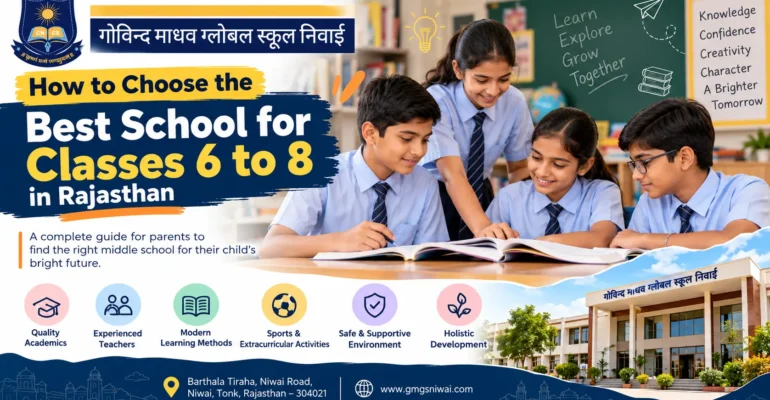
How to Choose the Best School for Classes 6 to 8 in Rajasthan
Choosing the right school is one of the most important decisions parents make for their children’s future. Classes 6, 7, and 8 are particularly significant because students begin moving beyond basic learning towards deeper subject understanding, independent thinking, problem-solving, and greater academic responsibility. The school they attend during these years can influence their confidence, learning habits, social skills, and readiness for secondary education.
For parents exploring the best school for Classes 6 to 8 in Rajasthan, the decision should involve more than checking examination results or comparing school fees. Teaching quality, individual attention, classroom practices, safety, extracurricular opportunities, and communication between teachers and parents all deserve careful consideration.
If you live in Niwai, Tonk, or nearby areas, finding a school that combines academic learning with personal development is especially important. Govind Madhav Global School (GMGS), Niwai, Tonk, is one local option parents can explore while comparing schools for their children.
This guide explains how to evaluate a middle school, which questions to ask before admission, and how to make a well-informed choice for your child’s educational journey.
Why Choosing the Right Middle School Matters
Classes 6 to 8 represent an important stage in middle-school education in India. During these years, children experience physical, emotional, intellectual, and social changes. They become more curious, start forming independent opinions, and gradually learn to take responsibility for their studies.
A supportive school environment can help children develop several essential skills.
Stronger academic foundations: Students explore subjects such as mathematics, science, social science, languages, and other areas in greater depth. A clear understanding of these concepts prepares them for the academic demands of Classes 9 and 10.
Independent learning habits: Students learn to manage homework, organise their notebooks, prepare for assessments, and revise lessons without constant reminders.
Confidence and communication: Classroom discussions, presentations, group assignments, and opportunities to ask questions help children express their ideas confidently.
Social and emotional development: Interacting with classmates teaches cooperation, empathy, respect, and conflict resolution. Supportive teachers can also help students manage academic pressure and changing emotions.
Problem-solving and critical thinking: Well-designed classroom activities encourage students to understand why something happens rather than simply memorising an answer.
For these reasons, parents should look for a school that supports both academic progress and the overall development of the child.
Check the School’s Academic Standards
Academic quality should be one of the first factors to evaluate when comparing schools in Niwai, Tonk, and other parts of Rajasthan. However, academic standards cannot be judged by examination results alone.
Consider the following points during your school search.
Teaching quality and teacher experience
Teachers play a central role in helping students understand difficult concepts. Ask about teachers’ subject knowledge, relevant qualifications, teaching experience, and approach to supporting students who learn at different speeds.
During a campus visit, observe whether teachers explain concepts clearly, encourage questions, and create a classroom atmosphere where children feel comfortable participating.
Conceptual understanding rather than rote learning
Students should understand the logic behind a mathematical formula, the scientific explanation for an everyday phenomenon, or the historical context of an event.
For example, when learning about electricity, students benefit from understanding how a simple circuit works instead of merely memorising definitions. Similarly, mathematics becomes more meaningful when teachers connect calculations with real-life situations.
Regular assessments and useful feedback
Assessments help teachers identify learning gaps before they become larger problems. Ask whether the school uses class tests, assignments, projects, oral assessments, and periodic examinations as appropriate.
Equally important is how teachers respond to the results. Constructive feedback should explain what a student has understood, what needs improvement, and how to make progress.
Doubt-clearing and individual attention
Every child learns differently. Some students understand a topic quickly, while others need additional examples or practice.
Ask how the school helps children who struggle with particular subjects and how teachers identify students who need extra support. Also, find out whether advanced learners receive opportunities to extend their understanding.
Preparation for higher classes
A good middle school gradually develops the study discipline, analytical thinking, reading comprehension, and subject knowledge students need for secondary education.
Parents should look for steady learning progress rather than an environment focused entirely on marks and competition.
Look for Modern and Student-Friendly Teaching Methods
The best school for Classes 6, 7 and 8 should offer learning experiences that encourage children to participate actively.
Traditional explanations remain valuable, but students often understand concepts more deeply when they can discuss, explore, experiment, and apply what they learn.
Look for teaching approaches such as:
- Activity-based learning: Using models, charts, demonstrations, and practical exercises to explain concepts.
- Project-based learning: Completing assignments that involve research, observation, creativity, and teamwork.
- Classroom discussions: Encouraging students to express opinions, ask questions, and consider different perspectives.
- Practical demonstrations: Connecting science and other subjects with observable examples from everyday life.
- Technology-supported learning: Using digital resources where appropriate to clarify difficult topics and support classroom teaching.
- Critical-thinking activities: Giving students opportunities to analyse information, solve problems, and explain their reasoning.
For example, a project about water conservation can combine science, geography, mathematics, and environmental awareness. Students may observe water use at home, prepare a chart, calculate approximate consumption, and suggest ways to reduce waste.
When visiting a school, ask teachers how they make lessons engaging and how they check whether students genuinely understand what they are learning.
Evaluate Infrastructure and Learning Facilities
A school’s physical environment affects students’ comfort, concentration, participation, and safety. Parents should check the facilities available rather than relying solely on photographs or promotional material.
Important areas to evaluate include:
- Classrooms: Are they clean, well-maintained, adequately ventilated, and suitable for learning?
- Science learning facilities: Are suitable resources available for practical demonstrations and age-appropriate scientific activities?
- Computer learning facilities: Do students have appropriate opportunities to develop digital literacy and computer skills?
- Library and reading resources: Are books and other learning materials available to encourage reading beyond textbooks?
- Sports and activity areas: Is there suitable space for physical education, games, and movement?
- Drinking water and sanitation: Are drinking water facilities and toilets clean and regularly maintained?
- Accessibility and general maintenance: Are classrooms, corridors, stairways, and common areas organised and maintained appropriately?
Parents should also ask about laboratory supervision, equipment maintenance, emergency arrangements, and access to first aid.
Remember that a long list of facilities does not automatically guarantee quality education. The more important question is whether the available resources are safe, useful, maintained properly, and meaningfully integrated into students’ learning.
Consider Sports and Extracurricular Activities
Academic learning is important, but children also need opportunities to explore their interests and develop skills outside the classroom.
Sports, art, music, dance, cultural programmes, debates, quizzes, and other age-appropriate activities can contribute to a child’s overall development.
Participation in sports, for example, teaches discipline, perseverance, teamwork, and respect for rules. Creative activities encourage imagination and self-expression, while debates and presentations can improve communication and confidence.
Extracurricular activities can also help students discover interests that they might not otherwise recognise.
When comparing a middle school in Rajasthan, ask:
- Which sports and extracurricular activities are available?
- How frequently do students participate?
- Are activities accessible to students with different abilities and interests?
- Do children receive opportunities to participate in competitions, performances, or group projects?
- How does the school balance activities with academic responsibilities?
A balanced school environment allows children to enjoy learning while developing a broader range of abilities.
Prioritise Student Safety and Well-Being
A safe, respectful, and emotionally supportive environment is essential for effective learning. Children should feel secure enough to ask questions, make mistakes, seek help, and build positive relationships.
Before selecting a school, ask about its safety practices and how responsibilities are managed.
Physical safety and supervision
Check campus entry and exit arrangements, visitor procedures, supervision during breaks, and safety practices in laboratories, playgrounds, and other activity areas.
If your child will use school transport, ask about vehicle safety, driver verification, supervision, pickup and drop-off procedures, and emergency communication arrangements.
Anti-bullying measures
Ask how the school responds to teasing, bullying, harassment, discrimination, and conflicts between students. Parents should understand whom their child can approach if they feel uncomfortable or unsafe.
Look for clear reporting procedures and a respectful approach to resolving problems.
Emotional support
Middle-school students may experience examination stress, friendship difficulties, changes in confidence, or anxiety about academic performance.
Teachers should respond constructively to these concerns and know when a child may need additional support. A positive school culture should encourage respect rather than humiliation or excessive pressure.
Hygiene and health arrangements
Observe the cleanliness of classrooms, toilets, drinking water areas, and common spaces. Ask about first-aid arrangements and how parents are contacted if a student becomes unwell or has an accident.
Safety policies should be explained clearly, and parents should verify the arrangements that matter most to their child’s circumstances.
Understand the Curriculum and Educational Approach
Before admission, make sure the school’s curriculum and teaching approach suit your child’s educational needs.
Ask the school to clarify:
- Which education board or curriculum the school follows.
- The medium or mediums of instruction.
- The subjects offered in Classes 6, 7, and 8.
- The assessment pattern and promotion criteria.
- The academic calendar and homework expectations.
- How the school prepares students for the transition to Class 9.
- Whether learning support is available when a child faces academic difficulties.
Do not assume that every school follows the same curriculum or assessment system. Confirm the current details directly with the school and review any relevant official information.
Parents should also consider their child’s language proficiency, learning preferences, and longer-term educational plans. A suitable school should provide a clear academic pathway without creating unnecessary pressure.
Evaluate Teacher-Parent Communication
A child’s education is most effective when teachers and parents work together.
Regular communication allows parents to understand their child’s strengths, identify challenges early, and provide appropriate support at home.
Before choosing a school, ask whether it provides parent-teacher meetings, academic progress updates, opportunities to discuss concerns, and a clear contact process for teachers or school administrators.
Good communication should cover more than examination marks. Parents should be able to discuss classroom participation, attendance, homework habits, behaviour, friendships, and areas where the child may need encouragement.
For example, if a student consistently struggles with reading comprehension, parents and teachers can work together on a practical improvement plan involving guided reading, vocabulary development, and regular feedback.
A school that values respectful, timely, and transparent communication can help families become more involved in their children’s progress.
Consider Location, Transport, Timings, and Affordability
Practical considerations matter when choosing the best school for your child. Even a school with an appealing academic approach may not be the right fit if the daily journey is exhausting or the overall costs are difficult for the family to manage.
Location and travel time
For families in Niwai and nearby parts of Tonk district, consider the daily distance between home and school. Long commutes can reduce time available for sleep, homework, recreation, and family interaction.
Visit the school during normal operating hours if possible to understand the likely travel conditions.
Transport arrangements
Ask whether school transport is available for your area, what routes are covered, how pickup and drop-off are managed, and whether the arrangements meet your family’s needs. Confirm current availability directly with the school.
School timings and routine
Check school timings, attendance expectations, homework requirements, and the overall daily schedule. Children need sufficient time for rest, meals, outdoor activities, and independent study.
Fee transparency
Request a written breakdown of applicable fees, including admission charges, tuition fees, transport, books, uniforms, activities, and any other relevant expenses.
Understand the payment schedule and refund policies, where applicable. Compare the overall cost with the education and support offered rather than selecting a school on price alone.
The right choice should be academically suitable, practically manageable, and financially sustainable for your family.
Why Consider Govind Madhav Global School, Niwai, Tonk?
For parents searching for schools in Niwai, Tonk, Govind Madhav Global School (GMGS), Niwai, is a local option worth exploring when comparing educational opportunities for Classes 6, 7, and 8.
Choosing a school close to home may make daily routines more manageable for families in Niwai and surrounding areas. However, proximity should be considered alongside teaching quality, student support, safety, curriculum, facilities, and the school’s overall approach to learning.
Rather than making a decision based only on online information, parents can take the following steps to evaluate GMGS:
Visit the campus: Observe the learning environment, classroom conditions, cleanliness, and general organisation.
Speak with teachers and school representatives: Ask how lessons are taught, how academic progress is assessed, and how students receive support when they encounter difficulties.
Understand the curriculum: Confirm the applicable board or curriculum, subjects, medium of instruction, assessment approach, and progression arrangements for the relevant classes.
Ask about facilities and activities: Verify which learning resources, sports opportunities, extracurricular programmes, and student-support arrangements are currently available.
Discuss admission and fees: Confirm seat availability, admission requirements, required documents, applicable fees, school timings, and transport options directly with the school.
These steps will help parents determine whether the school’s current educational approach matches their child’s needs and their family’s expectations.
For more information, visit the official website: https://www.gmgsniwai.com
School address: Barthala Tiraha, Niwai Road, Niwai, Tonk, Rajasthan – 304021.
Checklist for Parents Before Selecting a School
Use this practical checklist when visiting schools or comparing admission options.
- Academic quality: Are teaching methods clear, structured, and focused on understanding?
- Teachers: Do teachers have suitable qualifications and experience?
- Individual support: How are learning difficulties and individual needs addressed?
- Curriculum: Have you verified the board, subjects, medium of instruction, and assessment pattern?
- Infrastructure: Are classrooms, learning resources, sanitation, and activity spaces suitable and maintained?
- Safety: Are supervision, campus security, anti-bullying procedures, and emergency arrangements clear?
- Student well-being: Does the school promote respectful behaviour and provide appropriate support?
- Extracurricular activities: Are sports, creative activities, and opportunities for teamwork available?
- Parent communication: Can you discuss your child’s progress and concerns with teachers?
- Transport: Are routes, timings, safety arrangements, and charges suitable?
- Fees: Have you received a clear breakdown of all expected expenses?
- Admissions: Are seats available, and do you understand the admission process and documentation?
- Child’s comfort: Does your child feel comfortable with the environment and teaching approach?
After visiting two or three schools, compare your observations rather than relying on a single impression. If possible, include your child in the decision-making process so they can express their concerns and preferences.
Frequently Asked Questions (FAQs)
Q1. How do I choose the best school for Classes 6 to 8 in Rajasthan?
Compare teaching quality, curriculum, student safety, learning resources, extracurricular activities, communication with parents, location, and fees. Visit the shortlisted schools, ask specific questions, and consider which environment best supports your child’s academic and personal development.
Q2. What should parents look for in a middle school?
Parents should look for qualified teachers, strong subject foundations, regular assessments, constructive feedback, individual attention, suitable learning facilities, safe surroundings, extracurricular opportunities, and transparent communication.
Q3. Why are Classes 6 to 8 important for students?
These classes help students strengthen their subject knowledge, develop independent study habits, improve communication and problem-solving skills, and prepare for the academic and personal demands of secondary education.
Q4. How can parents evaluate teaching quality?
Ask about teacher qualifications, classroom practices, assessment methods, doubt-clearing arrangements, and support for students with different learning needs. Observe how teachers explain concepts and encourage participation during a school visit, where permitted.
Q5. What should parents check before visiting a school in Niwai, Tonk?
Check the school’s location, contact details, classes offered, current curriculum information, admission enquiry process, and likely travel arrangements. Prepare questions about teaching, safety, facilities, activities, fees, and transport so you can use the visit effectively.
Q6. How can parents enquire about admission at Govind Madhav Global School, Niwai?
Parents can visit the official website at https://www.gmgsniwai.com or contact the school directly to ask about admission availability for Classes 6, 7, and 8, eligibility, required documents, fees, and campus visits. Confirm the current details with the school before applying.
Conclusion: Make an Informed Choice for Your Child’s Future
Choosing the best school for Classes 6 to 8 in Rajasthan requires careful thought about what will help your child learn, grow, and feel supported. Academic standards matter, but so do teaching methods, individual attention, safety, extracurricular activities, communication, location, and affordability.
For families exploring schools in Niwai and Tonk, comparing available options through campus visits and direct conversations with school representatives is a practical way to make a confident decision.
Govind Madhav Global School, Niwai, Tonk, can be included in your shortlist as you explore local educational opportunities. Take time to understand its current curriculum, teaching approach, facilities, admission availability, and fee structure before deciding whether it is the right fit for your child.
Explore Govind Madhav Global School, Niwai, and take the next step towards your child’s educational journey.
Website: https://www.gmgsniwai.com
Address: Barthala Tiraha, Niwai Road, Niwai, Tonk, Rajasthan – 304021.